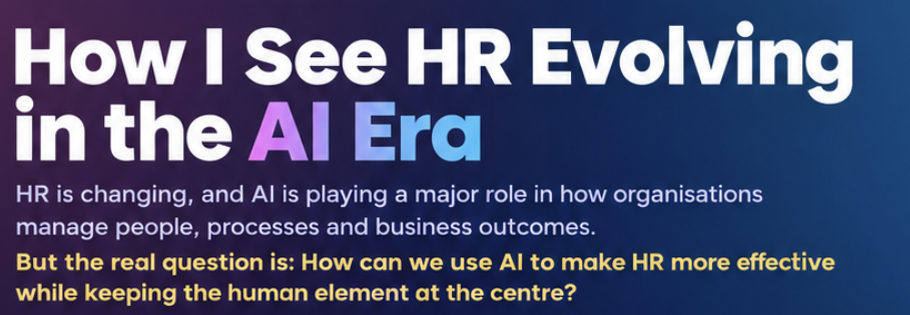
Let’s talk about the future of HR.
Every organisation is asking how AI can make HR faster, smarter, and more efficient.
But I believe we’re missing a much bigger question:
Are we redesigning HR for the future, or simply automating the way we’ve always worked?
Because automating a broken process doesn’t make it better. It just makes the problem move faster.
The real opportunity is to rethink how HR operates, where people expertise sits, and how technology supports better business decisions.
Four ways I see HR evolving in the AI era
1. From administrative HR to AI-powered HR
Routine workflows, employee queries, reporting, and data processing can increasingly be supported by AI.
But the goal isn’t to eliminate the human role in HR.
It’s to give HR professionals more time for strategic thinking, workforce planning, employee relations, and decisions that require experience and judgement.
2. From isolated HR teams to connected ecosystems
HR cannot deliver business outcomes alone.
Managers, technology platforms, external specialists, and internal HR teams need to work together.
The future is not about adding more tools. It’s about making the entire people ecosystem work better.
3. From technology-led decisions to expert-led decisions
AI can identify patterns, analyse data, and provide recommendations.
But can it fully understand workplace context, employee emotions, organisational culture, or the consequences of a sensitive people decision?
Not reliably on its own.
Human judgement, empathy, accountability, and oversight must remain central to HR.
Technology should strengthen expertise, not replace responsibility.
4. From HR-owned processes to people-led businesses
People management should not sit entirely with HR.
Managers must take ownership of everyday people decisions, supported by clear policies, practical frameworks, coaching, and guidance from HR.
HR’s role is to make good people management possible across the organisation, not to become the answer to every people-related question.

So, which HR operating model is right?
There is no universal answer.
A growing SME may need a flexible, expert-led HR function. A larger organisation may benefit from a connected ecosystem of internal teams, AI tools, and specialist partners. Another business may need stronger people-management capabilities embedded directly into its operations.
The right model depends on business goals, workforce complexity, management capability, AI maturity, risk, and scale.
This is why HR transformation must begin with business needs, not technology trends.
My perspective as an HR advisor
I don’t believe the future of HR is about choosing between people and AI.
It’s about knowing what to automate, what to empower managers to own, what requires specialist expertise, and where human judgement must never be compromised.
The organisations that get this right won’t simply have faster HR processes.
They’ll be better equipped to make informed decisions, manage people risks, build stronger workplaces, and grow sustainably.
The question isn’t whether AI will change HR. It already is.
The real question is whether HR is ready to change the way it creates value for the business.
💬 If you were redesigning HR for the AI era, what would you change first: the processes, the structure, or the mindset?
#HRStrategy #FutureOfWork #ArtificialIntelligence #HRTransformation #Leadership